Fundamentals · October 2026
What is workflow automation, and why does your small business need it?
A plain-language explanation of what workflow automation actually is, what it isn't, and when it starts paying for itself.
Picture a busy Monday. The invoices still need to go out. Three client follow ups are sitting in a notebook from last week. A lead that came in over the weekend hasn't been called back yet. The team meeting notes need typing up before anyone forgets what was decided. None of this is hard work. It's just a lot of it, and it all landed on the same desk before the week even got going.

That scene repeats itself in some form in almost every small business we've worked with. The business isn't struggling because the work is complicated. It's struggling because the same manual steps happen over and over, and every one of them has to be remembered, typed, copied, or chased down by a person. That gap, between work that needs to get done and work that only gets done because someone remembered to do it, is exactly what workflow automation closes.
What workflow automation actually is
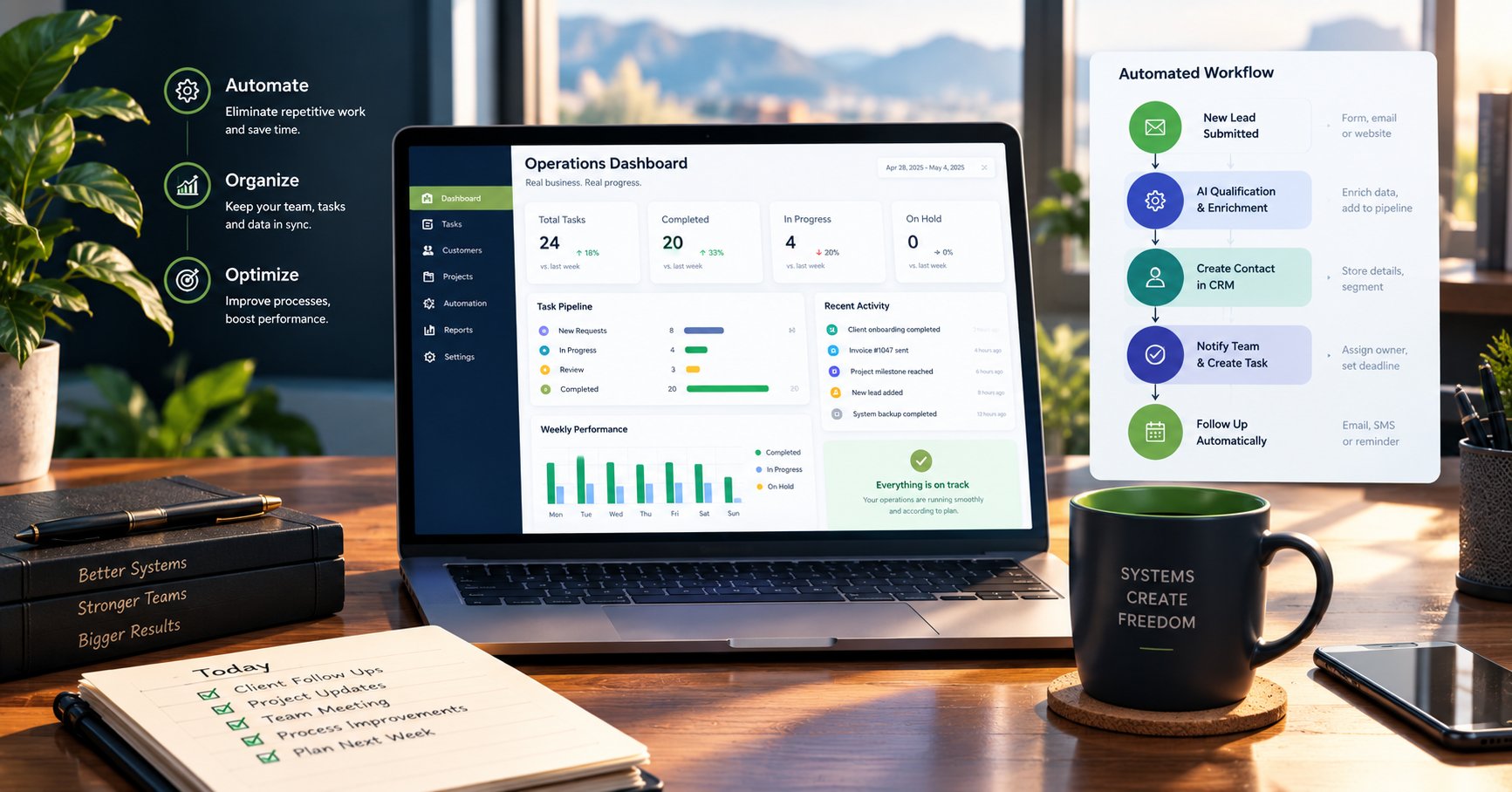
Workflow automation is software that takes a repeatable task and runs it for you, triggered by something that already happens in your business. A new lead fills out a form, and instead of sitting in an inbox, it's automatically logged, scored, and assigned to the right person. A job gets marked complete, and the invoice goes out on its own. A customer books an appointment, and a confirmation and reminder get sent without anyone typing a word.
The key word is repeatable. Automation isn't for the one off decision that needs judgment. It's for the steps you'd do the exact same way every single time anyway, the ones that don't need a person's brain, just a person's time.
What it isn't
It isn't a robot replacing your team. The businesses that get the most out of automation aren't trying to remove people, they're trying to stop wasting them on work a computer can do faster and more consistently. Your team's time goes back into the parts of the job that actually need a human: talking to customers, solving problems, growing the business.
It also isn't one giant piece of software you buy and hope solves everything. Most useful automation is small and specific. It's a handful of systems, each one built around a real bottleneck, working together quietly in the background. That's a very different thing from a subscription you pay for and never fully learn how to use.
Where it actually shows up
In practice, workflow automation tends to cluster around a few places in a business: capturing and routing leads, scheduling and reminders, invoicing and follow up, reporting that currently gets built by hand, and anything where information has to be copied from one system into another. If you've ever said "I know this is inefficient, but it works," that task is a strong candidate.
A good way to spot a candidate is to ask whether a task has a clear trigger and a clear outcome, with a predictable set of steps in between. If the answer is yes, it's very likely something that doesn't need a person doing it manually anymore.
When it starts paying for itself
Automation earns its cost the moment the time it saves is worth more than what it took to build. For most small service businesses, that line gets crossed faster than expected. A task that takes fifteen minutes doesn't sound like much until you multiply it by every day of the year, and by every person who's doing some version of it. Hours add up fast, and so does the cost of mistakes that happen when a tired person is doing the same copy and paste task for the hundredth time.
The businesses that benefit most aren't necessarily the biggest ones. They're the ones where a handful of people are covering work that used to take a much larger team, and where every hour someone spends on manual admin is an hour they're not spending on customers or growth.
If any part of this sounds like your week, the fix usually isn't a bigger team. It's finding the handful of repeatable tasks quietly eating your time and building a system that runs them for you. Want to see what that actually looks like in a real business? Here's a case study on exactly that.
← Back to the blogYour operation is next.
The audit is free. If there's nothing worth automating, we'll tell you.