Case Study · Courier & Logistics
A real-time tracking system for a courier service.
From scattered updates to a live operations view, one shared map for both supervisors and drivers.
At a glance
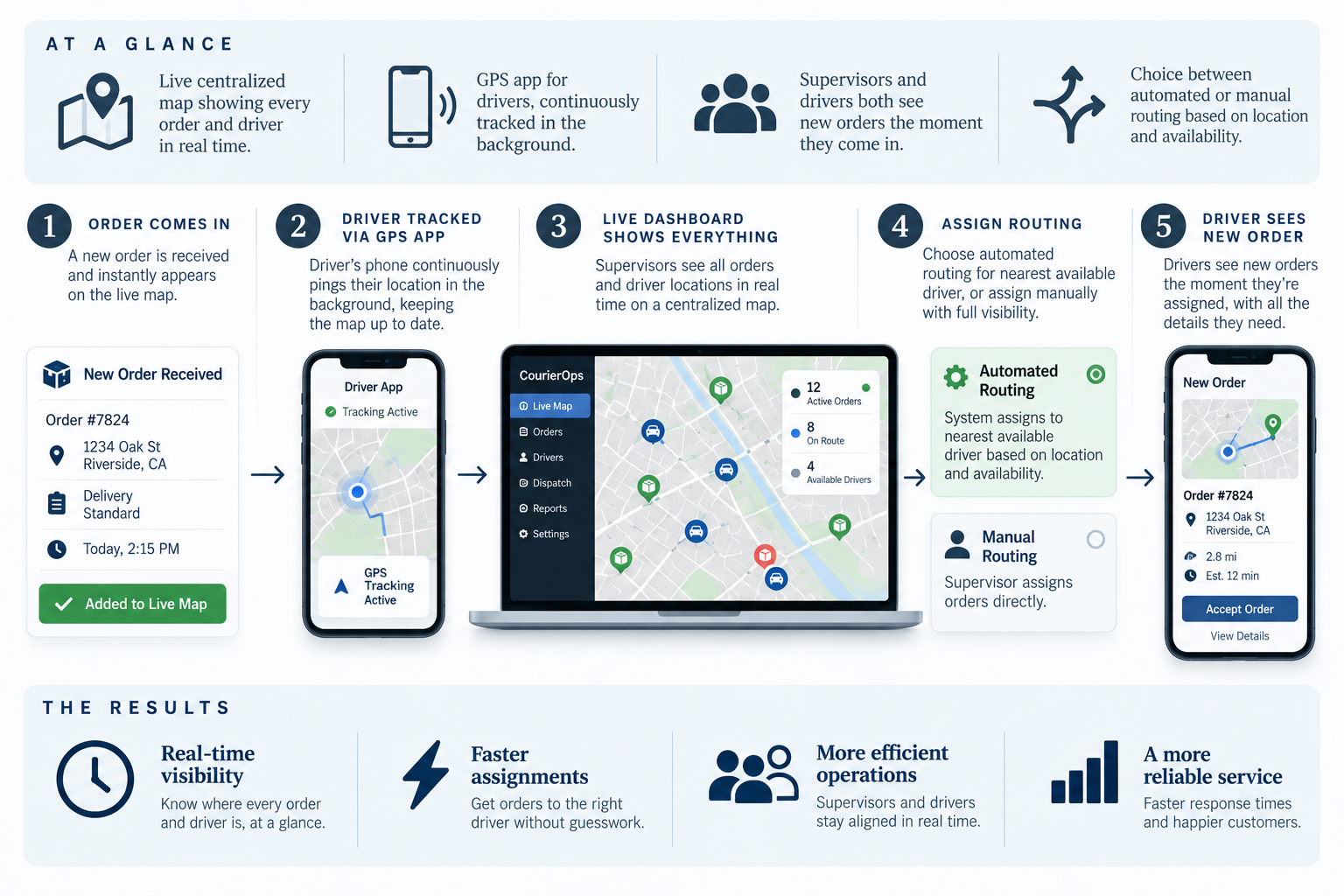
- ✓Live centralized map showing every order and driver in real time
- ✓GPS app for drivers, continuously tracked in the background
- ✓Supervisors and drivers both see new orders the moment they come in
- ✓Choice between automated or manual routing based on location and availability
The Challenge
For this courier service, knowing where every order and every driver actually stood at any given moment wasn't something anyone could see clearly. Order status and driver location lived in separate places, if they were tracked at all, which meant the supervisor team had no real way to answer a simple question in the moment: which driver is closest, who's available, and where is this order right now.
Without that visibility, assigning jobs efficiently meant relying on guesswork or manual check-ins, and drivers themselves had no live view of new work coming in, they were dependent on someone else noticing an order and reaching out to assign it.
What We Built
We built a live tracking system that turns every incoming order into a point on a centralized map, giving both supervisors and drivers real-time visibility into orders and driver locations as they happen.
On the supervisor side, we built a live dashboard showing every order's destination on a map alongside the real-time location of every driver. On the driver side, we built a GPS app that runs on each driver's phone, continuously pinging their location in the background so their position is always reflected on the supervisor dashboard without any manual check-in required.
The dashboard also gives supervisors a choice in how jobs get assigned, they can let the system automatically route orders to drivers based on location and availability, or step in and assign jobs manually when they want direct control.
How It Works
As soon as an order comes in, it appears on the centralized map in real time, visible to both the supervisor team and drivers. Each driver's phone continuously pings their location in the background through the GPS app, keeping their position accurate on the dashboard at all times without requiring them to do anything.
From there, the supervisor team decides how that order gets assigned. With automated routing on, the system matches the order to the nearest available driver automatically based on real-time location and availability. With manual routing, a supervisor can view the map, see exactly where every driver is, and assign the job themselves, switching between the two modes as the situation calls for it.
The Results
Both supervisors and drivers now have a live, shared view of orders and driver locations as they happen, instead of working from outdated or incomplete information. Supervisors can assign jobs with actual visibility into who's closest and available, whether they choose to let the system handle it automatically or take manual control, and drivers no longer wait to be told about new work, they see it appear in real time.
The Takeaway
The core problem wasn't a lack of drivers or orders, it was a lack of shared visibility between the people managing the work and the people doing it. By putting both order status and driver location on one live map, and giving supervisors the flexibility to automate routing or take it over manually, the courier service closed the gap between an order coming in and the right driver getting to it.
Your operation is next.
The audit is free. If there's nothing worth automating, we'll tell you.