Case Study · Operations Team
From full-day manual sorting to real-time order routing.
An automated workflow system that reads, routes, and tracks every order, without losing human oversight.
At a glance
- ✓100+ orders processed automatically every day
- ✓Routing that used to take a full team all day
- ✓Roughly 8 hours saved daily
- ✓Orders reach the right regional representative the moment they arrive
The Challenge
Orders came into this operations team by fax, arriving throughout the day in unpredictable volume, each one requiring a person to read it, pull out the key details, name and location, and figure out which region it belonged to. From there, that team member had to manually create a digital copy of the order and place it onto the correct location board, where it would then be assigned to the representative covering that specific area.
With 100 or more orders coming through daily, that meant a significant portion of the team's day was spent reading faxes, transcribing details by hand, and manually sorting orders onto the right board, before any actual work on the order could begin. The process depended entirely on someone being available to read each fax correctly and route it without error, and any backup in that first step delayed everything downstream, orders sitting untouched while representatives waited on work that hadn't been assigned to them yet.
What We Built
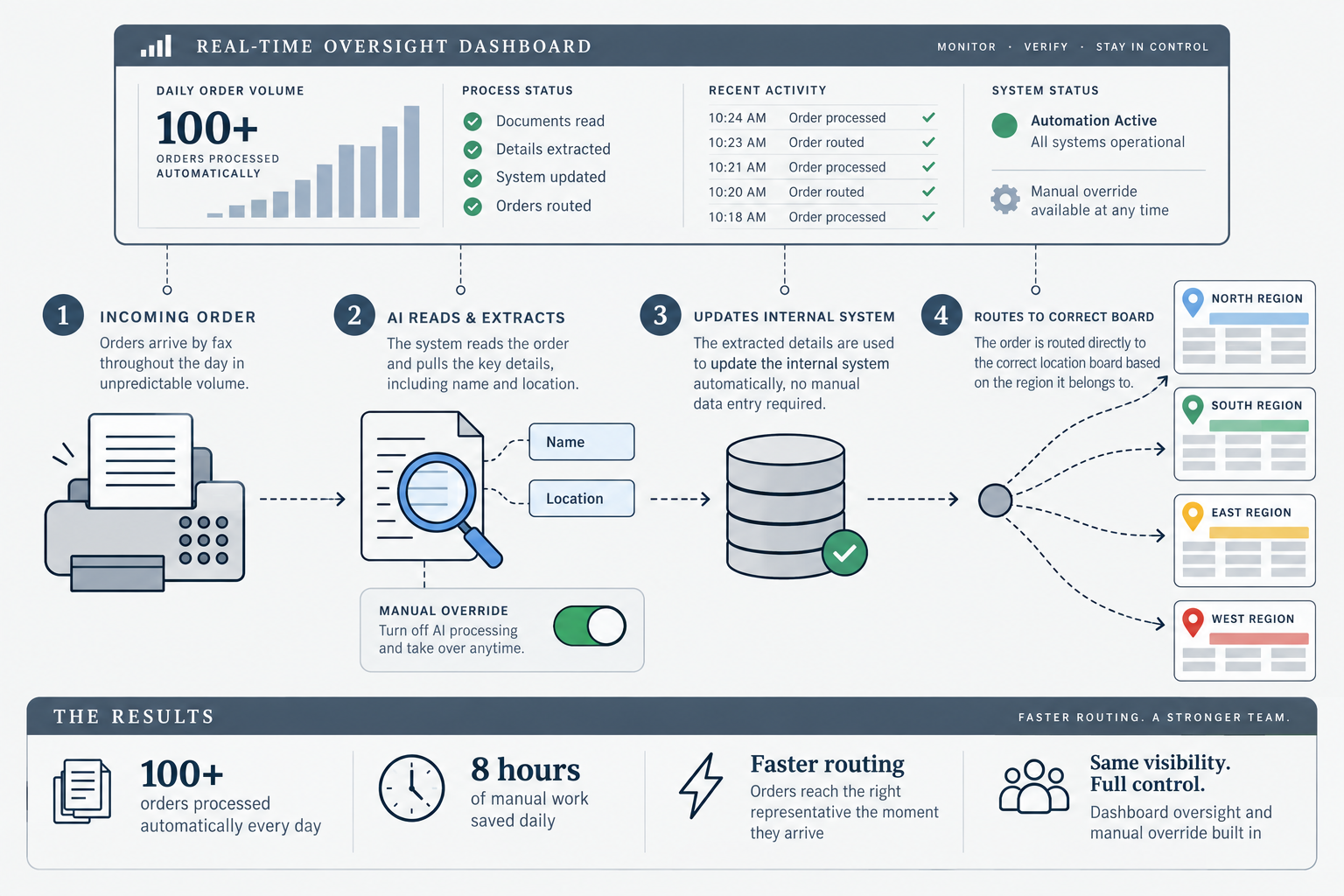
We designed and built an AI-led process that reads incoming orders directly, extracts the details needed, including name and location, updates the internal system automatically, and routes each order to the correct location board based on where it needs to go, without a person reading, transcribing, or manually placing a single order.
Automation didn't mean removing oversight. Alongside the routing system, we built an internal dashboard giving the team a clear daily overview of every order that came in and the work performed on it, so nothing runs unseen. We also built in a manual override, letting a human representative turn off AI processing at any point and take over directly when needed.
How It Works
When an order comes in, the system reads it and pulls the relevant details straight from the document. Those details are used to update the internal system automatically, no manual data entry required, and the order is then routed directly to the correct location board based on the region it belongs to. From there, it's already positioned for the right representative to pick up, with no manual transcription or sorting step standing in the way.
Human oversight runs alongside the automation, not separate from it. The dashboard gives the team visibility into daily order volume and what's been done with each one, making it easy to verify that sorting is happening correctly. If a representative ever needs to step in directly, the override feature lets them turn off AI processing and handle an order manually, without waiting on anyone else to make that change.
Because this happens the same way on every order, the process holds up regardless of volume or how the workload is distributed across regions on a given day.
The Results
The system now processes more than 100 orders a day automatically, work that previously required a person to read, transcribe, and manually sort every single one by hand. That manual reading and routing process has been cut down to roughly 8 hours of work saved daily, time the team now spends on higher-value work instead of transcription and sorting.
Orders also reach the correct regional representative significantly faster, since there's no longer a wait for someone to read a fax, type up the details, and manually place it on the right board. And because the dashboard and override are built in, the team never lost visibility or control in exchange for that speed.
The Takeaway
The real bottleneck here wasn't the volume of orders, it was that every single one required a human to read it, extract the same handful of details, and manually route it before anything else could happen. That's exactly the kind of repetitive, rule-based decision that automation handles well, especially when it's paired with real oversight instead of replacing it. Once that step was automated, the team stopped spending their day on data entry and got that time back for actual work, without giving up the ability to see what was happening or step in when they needed to.
Your operation is next.
The audit is free. If there's nothing worth automating, we'll tell you.